


 By Guest - August 12, 2026
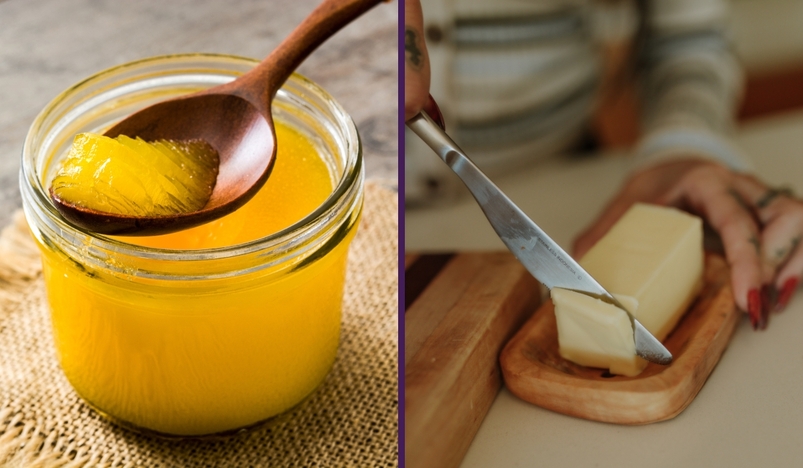
Ghee and butter are kitchen staples across much of the world, and the debate over which is better for cooking is a long-running one. Both come from the same source, yet they behave differently in the pan and on the plate. The honest answer is that neither is a health miracle, and neither is a villain; what matters is how you cook, how much you use, and the rest of your diet. Here is how the two compare on the points that count.
What's the difference?
Ghee is essentially clarified butter. It is made by gently heating butter until the water evaporates and the milk solids separate out and are strained away, leaving pure golden butterfat with a nutty aroma. Butter, by contrast, is around 80 percent fat, with the remainder made up of water and milk solids. That single difference, the removal of water and milk solids, drives almost everything else that sets the two apart.
Cooking and smoke point
This is where ghee has a clear practical edge. Because its milk solids have been removed, ghee has a high smoke point of roughly 250 degrees Celsius, well above butter's smoke point of around 150 to 175 degrees Celsius. The milk solids in butter are what brown and then burn at higher temperatures, producing an acrid taste and potentially harmful compounds. For high-heat cooking, frying, sauteing and searing, ghee is the more stable and forgiving choice, while butter is better suited to low-heat cooking, finishing and baking.
Fat and calories
Both ghee and butter are high in saturated fat, and here ghee is actually slightly more concentrated. Because it is pure fat with the water removed, a tablespoon of ghee contains marginally more calories and fat than the same measure of butter. The two are broadly comparable, and neither should be treated as a low-calorie ingredient. Health authorities generally advise keeping saturated fat intake moderate, which applies equally to both.
Lactose and casein
For anyone sensitive to dairy, this is where ghee stands out. Because the milk solids are strained away during clarification, ghee is very low in lactose and casein, the milk sugar and protein that many people struggle to digest. That makes it easier to tolerate for those who are lactose intolerant or sensitive to dairy proteins, whereas butter retains small amounts of both.
Nutrients
Both are sources of fat-soluble vitamins, including A, E and K, and both carry the rich flavour that makes them so widely used. Ghee also contains butyrate, a short-chain fatty acid, and small amounts of conjugated linoleic acid. These are often cited as benefits, but the quantities are modest, and they are not a reason to consume ghee in large amounts. As with butter, the nutritional case rests on moderation rather than superfood claims.
The verdict
So which is healthier? For most everyday cooking, especially anything involving high heat, ghee has the practical advantage thanks to its higher smoke point and its lack of lactose and casein. Butter remains an excellent choice for baking, finishing dishes and low-heat cooking where its flavour shines. Nutritionally the two are close cousins, both rich in saturated fat and best enjoyed in moderation. Rather than crowning a single winner, the sensible approach is to use each where it performs best and to keep portions sensible within a balanced diet.
General information only; not a substitute for personalised dietary or medical advice. Smoke points are approximate and vary by product.

_20-08-2026_05-08.jpg)
_27-51-2026_11-51.png)
_27-43-2026_12-43.png)



.jpg)
.jpg)




.jpg)


.jpg)
.png)
.jpg)













Leave a comment